Happy Wednesday!
I want to take you back to my college football days for a second.
There was a period when I was training my butt off, eating what I thought was “enough,” lifting hard, practicing even harder…and somehow getting smaller.
I’d finish a long, brutal practice in the heat and step on the scale down four or five pounds. Most of this weight was water, glycogen, electrolytes, and muscle tissue being burned off to survive practice.
At the time, I thought that was just part of the game.
You suffer. You grind. You lose weight during the week and try to backfill with as much food as you can to keep your weight up through the season.
Then our strength coaches made one simple change.
They started handing us carbohydrate drink powders during practice.
Almost immediately, everything changed.
I stopped shrinking during the week.
My strength didn’t fall off late in practice.
My performance in games improved.
I recovered faster between sessions.
And for the first time, I understood something that performance lives and dies by fuel timing.
Today, I will discuss why carbohydrates are so crucial for building and retaining muscle.
Carbs are not the Enemy
I want you to think of carbohydrates as high-octane fuel.
Fat is great for long, slow, steady-state output.
Protein is essential for repair and structure.
But when intensity rises (HIIT, lifting, pushing volume), your body demands carbohydrates.
Research consistently shows that carbohydrate availability improves performance by 3–12%, depending on duration and intensity.
That might not sound dramatic until you realize that a 5–10% increase in performance compounds across every rep, every set, every workout.
In resistance training, greater carbohydrate availability helps you maintain training volume.
And volume is the single most important driver of hypertrophy.
In studies where athletes consumed carbs before, during, and after training, total work output was 10–15% higher compared to placebo groups.
If you’re under-fueled, your body will borrow energy from muscle tissue to get through training.
If you’re properly fueled, muscle is preserved, and performance stays high.
Carbs don’t make you fat.
Mistimed, excessive calories do.
The Engine
Here’s the simplest way I explain carb timing to clients.
Pre-workout carbs fill the tank.
Peri-workout carbs keep the engine cool.
Post-workout carbs refill the system for tomorrow.
Most people either skip fuel entirely or dump carbs at random throughout the day and hope for the best.
Neither works well.
When you lift weights, you’re repeatedly asking your nervous system and muscle fibers to fire at high output.
That output is powered primarily by muscle glycogen.
Pre-workout carbs give you the starting line advantage.
Peri-workout carbs prevent the mid-session performance drop-off.
Post-workout carbs decide whether you recover or dig a deeper hole.
This is why athletes who train hard but go low-carb often plateau or lose muscle.
They’re disciplined, but metabolically under-supported.
Strategic carbohydrate timing lets you train harder and stay lean, because you’re giving fuel when it’s actually used, not stored.
Pre-Workout Carbs
Studies looking at pre-exercise carbohydrate ingestion show consistent improvements in sustained power output and time-to-fatigue.
In one classic study, athletes consuming carbohydrates before training improved performance by 3–6% compared to water, regardless of whether carbs were consumed 15, 45, or 75 minutes beforehand.
Why does this matter for lifting?
Because muscle glycogen and blood glucose availability determine how many quality reps you can produce before fatigue sets in.
When glycogen is low, cortisol rises faster, perceived exertion increases, and strength drops earlier in the session.
You don’t need a massive pre-workout meal. In fact, too much slows digestion and backfires.
For most people, 20–40g of fast-digesting carbohydrate paired with protein is enough to:
• stabilize blood sugar
• reduce early fatigue
• preserve muscle tissue
• improve pump and mind-muscle connection
We always want to show up to training metabolically prepared.
Peri-Workout Carbs
This is where things get interesting.
Peri-workout carbs don’t necessarily make you stronger on the first set.
They help you stay strong throughout the entire session.
Research shows that consuming carbohydrates during training reduces perceived exertion, stabilizes blood glucose, and improves total work output.
In resistance-trained athletes, carbohydrate supplementation during workouts has been shown to preserve 10–15% more training volume.
This matters because hypertrophy is built on your worst sets not falling apart.
There’s even data showing that carbohydrate mouth rinses (you don’t even swallow the carbs) improve endurance and cognitive output during training.
Thus, your brain responds to carbs just as much as your muscles.
Peri-workout carbs act like a cooling system in a high-performance engine.
Without them, output drops as heat and stress rise. With them, performance stays stable under load.
This is the exact principle our strength coaches used in football, and it’s still one of the biggest performance hacks available.
Post-Workout Carbs
Post-workout carbs determine whether your body recovers or stays catabolic.
Studies show that carbohydrate ingestion after training can increase muscle glycogen resynthesis by 45–50% compared to no carbs.
They also reduce cortisol and muscle protein breakdown, which is critical if you’re training frequently.
Protein builds muscle.
Carbs protect it.
One of the most interesting findings in exercise physiology is that carbohydrate ingestion alone improves net muscle protein balance by reducing breakdown, even without protein.
When you combine carbs with protein post-workout, you create the ideal hormonal environment.
Insulin rises modestly, cortisol falls, and nutrients are driven into muscle tissue instead of being burned for survival.
This is how you stay lean while growing.
My Protocol
Here’s the exact framework I recommend to most people lifting weights:
Pre-Workout (30–90 min before):
• 20–40g fast carbs
• 20–40g protein
Peri-Workout:
• 10–20g high-quality carbs in water
• Increase to 20–40g for longer sessions
Post-Workout (within 1–2 hours):
• 25–50g carbs
• 25–50g protein
For the rest of the day, I recommend moderate carbs, high protein, and steady fats.
This approach maximizes training output, preserves muscle during fat loss, and supports a healthy metabolism.
And this brings me to something important.
My Favorite Carb Supplement
For years, I tried to build the perfect intra-workout drink myself.
I bought cyclic dextrin from one company.
EAAs from another.
Electrolytes somewhere else.
Magnesium. Chromium. Taurine.
I was measuring, mixing, and spilling powders all over my kitchen like a mad scientist before training.
It worked, but it was annoying, inconsistent, and unnecessary.
That’s why Unmatched Supps INTRA caught my attention.
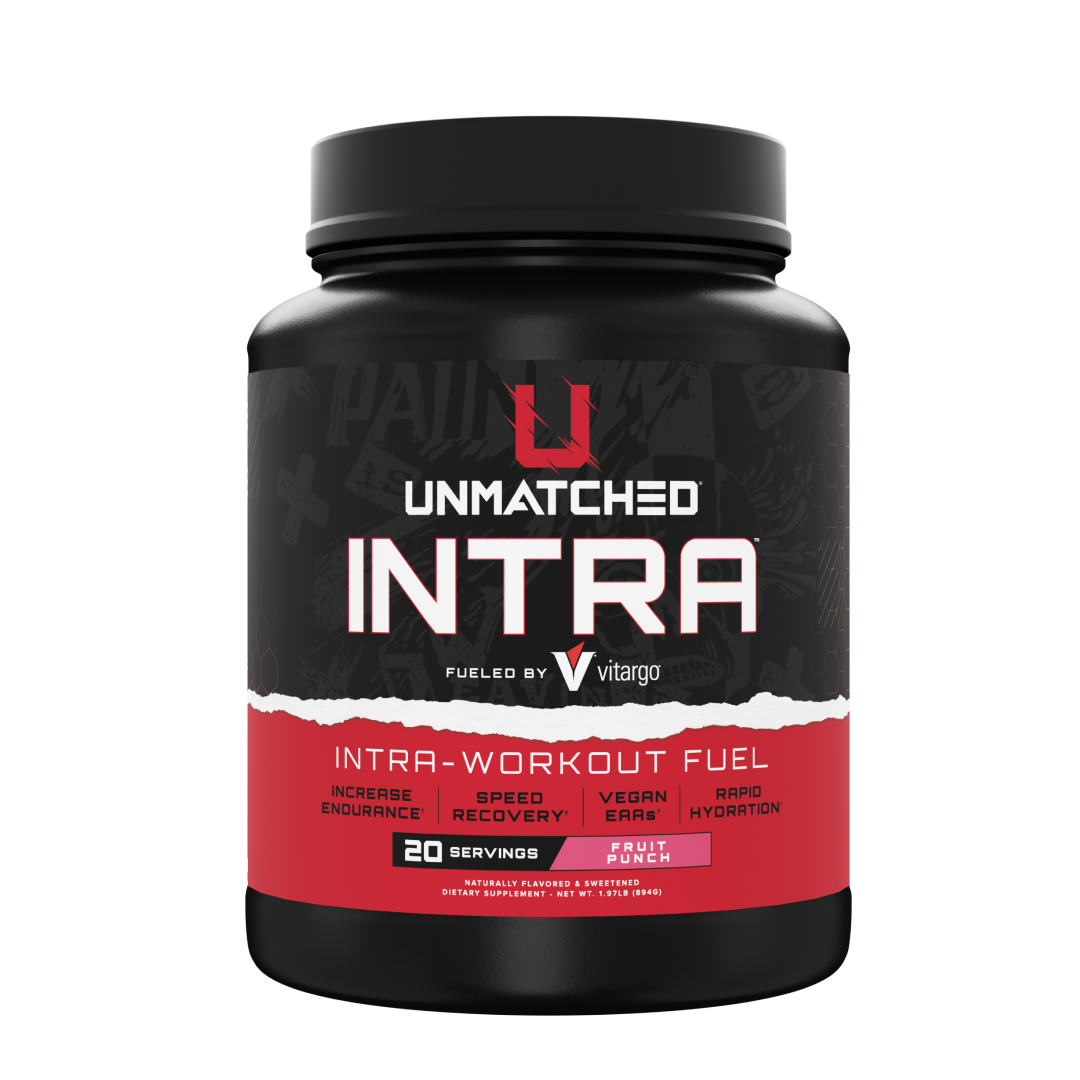
It’s everything I want in a peri-workout drink:
Vitargo® - a patented high-molecular-weight carbohydrate derived from barley, not cheap generic HBCD
EAAs to protect muscle during training
Electrolytes + coconut water powder for hydration
Chromium + magnesium to improve glucose handling
Low osmolality, fast gastric emptying, no gut issues
Vitargo® is not the same as cheaper HBCD or maltodextrin blends.
It’s a different carbohydrate entirely, with unique absorption and performance properties.
This fits perfectly into the peri-workout strategy we just covered.
I sip it during training and don’t think about it.
For the first time in years, I don’t have to build my own intra-workout drink.
It keeps me pushing through my entire workout and helps me avoid the mid-workout crash that so many people experience.
If you are not accustomed to timing carbohydrates around your training, I recommend you start right away.
Your muscles will thank you!
Best,
Hunter Williams
References
Pre-exercise carbohydrate improves performance (Febbraio et al., 2000) — https://journals.physiology.org/doi/10.1152/jappl.2000.89.6.2220
CHO during exercise delays fatigue & maintains output — https://www.sciencedirect.com/science/article/abs/pii/S0899900704001169
Early post-exercise carbs speed glycogen resynthesis — https://pubmed.ncbi.nlm.nih.gov/3132449/
ISSN carbohydrate nutrient timing position stand — https://jissn.biomedcentral.com/articles/10.1186/s12970-017-0189-4