Happy Friday!
I hope you and your family had a fantastic Christmas yesterday.
I just dropped a new video on Spotify breaking down one of the most common questions I get inside the hormone world.
Intramuscular (IM) testosterone injections vs subcutaneous (SubQ) injections.
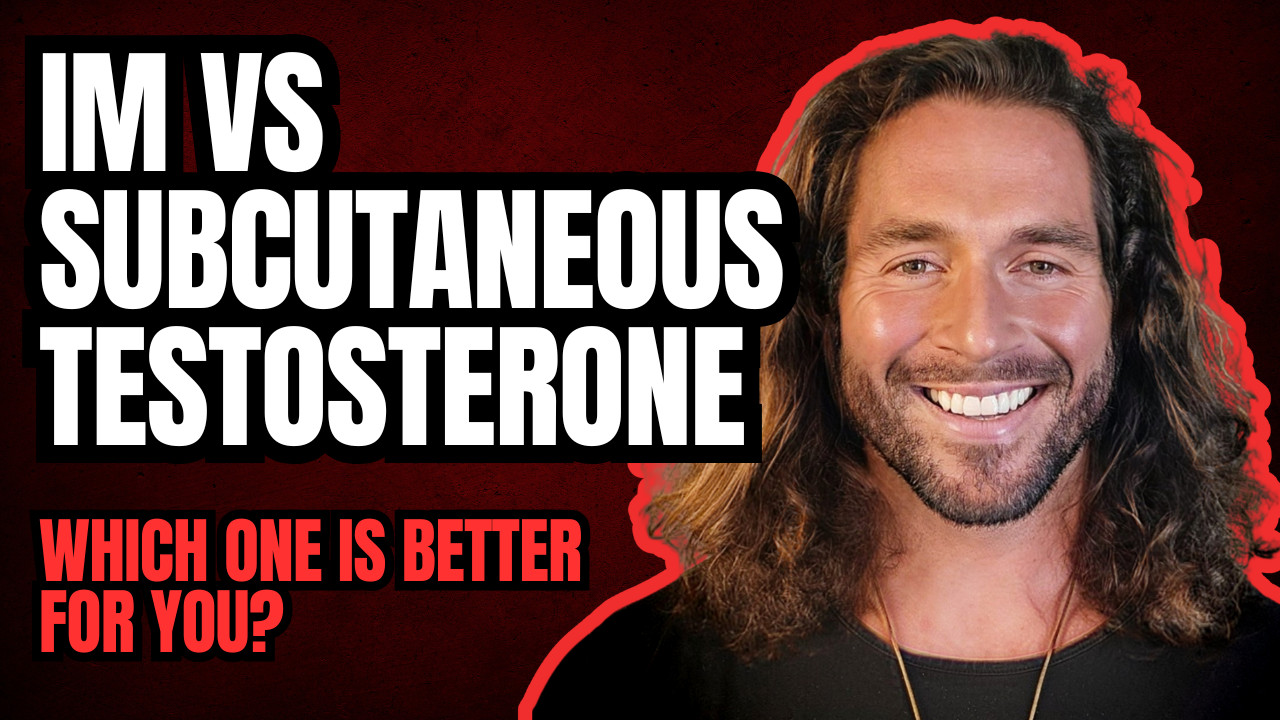
Quick spoiler: there’s no single “right” answer.
Some people thrive on SubQ.
Some people thrive on IM.
And a lot of the “TRT problems” people blame on testosterone are actually problems with delivery mechanics like peak-to-trough swings, injection frequency, volume, carrier oils, body fat percentage, and how consistent someone is week to week.
In the video, I share my own preference upfront.
I prefer IM injections, and I prefer them for a very specific reason.
I do them every other day, which keeps me from getting the steep drop-off that can happen when people inject once per week.
And I do them in a small volume (25–30 units on a 28g insulin syringe), so I don’t get post-injection pain, and I still get a good “punch” from the therapy.
Now let’s walk through the science and the real-world logic so you can make the best decision for your life.
FYI, you can get 40% off the entire store at BioLongevity Labs and an additional 15% off when you use code HUNTERW at checkout.
The Big Picture
TRT exists to restore testosterone to physiologic, functional ranges and relieve symptoms tied to androgen deficiency.
For men, the classic symptom cluster is fatigue, low libido, reduced muscle mass and recovery, mood changes, and the “I don’t feel like myself” baseline.
For women, it’s often framed more narrowly in mainstream medicine. Still, once a woman hits perimenopause and menopause, testosterone decline can be one of the biggest drivers of low desire, low resilience, and reduced vitality when everything else looks “normal.”
So when we compare IM vs SubQ, the real question is…
Which route gives you stable levels you tolerate well, with the fewest side effects, and the highest long-term compliance?
Because the best protocol in the world doesn’t matter if you hate doing it.
And this is where route + dosing frequency comes into play.
Pharmacokinetics
Here’s what the data and real-world experience line up on:
IM injections tend to absorb faster because you’re putting the depot into vascular muscle tissue. That can translate into higher peaks, especially if the dose is large or infrequent.
SubQ injections tend to absorb more gradually through subdermal fat with more lymphatic uptake, often producing a flatter curve week to week.
Weekly SubQ testosterone has been shown to keep serum testosterone relatively stable across the interval in studied patients, which supports the idea that SubQ can smooth out the ride.
If someone is only going to inject once per week, SubQ can make a ton of sense because the curve stays flatter.
If you’re willing to inject every other day or daily, IM becomes much more preferable.
The trough doesn’t have time to fall off a cliff, and you can get the “feel” of IM without the roller coaster.
Studies
One of the most useful comparisons we have is the 2022 paper looking at IM testosterone cypionate versus a SubQ testosterone enanthate auto-injector in hypogonadal men.
IM cypionate can create supraphysiologic peaks, and the SubQ auto-injector was designed to lower the peak-to-trough ratio.
The key findings were:
Trough total testosterone ended up pretty similar between groups after treatment.
The IM group produced higher peaks.
The SubQ approach was associated with smaller rises in some downstream markers they tracked (notably estradiol and hematocrit in their analysis).
This is where people get dogmatic. Some will say “higher peaks are bad.” Some will say “higher peaks are good.”
It depends on whether your peaks are too pronounced and whether your troughs are too low.
High peaks and deep troughs are where guys start reporting that post-shot surge followed by a fade-out before the next dose. If you tighten the dosing schedule, you change the whole experience.
Estradiol and Hematocrit
Estradiol (E2) gets demonized online, and that’s one of the biggest mistakes people make with TRT.
I want testosterone to aromatize into estrogen at the right level. Estradiol is protective. It’s part of healthy male physiology and female physiology.
Route and frequency can influence E2 because E2 tracks with testosterone concentration peaks.
That’s why the IM-vs-SubQ comparison paper points out that IM cypionate can drive bigger peak dynamics, and the SubQ auto-injector was designed to reduce that.
Same story with hematocrit.
Testosterone stimulates erythropoiesis, and that effect is dose- and exposure-pattern dependent.
If you get massive peaks, you can see a bigger hematocrit response.
The 2022 comparison paper explicitly focused on this issue because it’s clinically relevant for men who run high on hematocrit.
If you’re healthy, training, hydrated, not inflamed, and you’re dosing intelligently, hematocrit is almost always manageable.
If you’re not living clean, SubQ and/or a tighter injection schedule can reduce the extremes.
Women
Women often get underdosed or mis-dosed because they’re handed a 200 mg/mL “male concentration” vial, then told to inject microscopic volumes once per week.
In the real world, that can lead to inconsistent exposure and inconsistent results.
Women respond similarly to men in the sense that stable, appropriate levels drive the benefits.
The mistake is pushing the dose too high (virilization risk) or dosing so inconsistently that nothing meaningful happens.
Route matters less than dose accuracy and frequency.
Mast Cells
SubQ can produce more mast-cell–type reactions in some people because the depot sits in a more reactive environment.
Mast cells are prominent in tissues exposed to the environment, including skin.
If you’re sensitive, a slower-absorbing SubQ depot can mean excipients sit in contact with that tissue longer.
And a lot of “testosterone reactions” are not reactions to testosterone, they’re reactions to the vehicle or excipients.
So if someone gets localized hives, itching, swelling, nodules, or feels inflamed after SubQ, I start thinking about:
injection depth (too superficial)
volume per site (too much depot)
carrier oil choice
excipient sensitivity
body fat + inflammatory environment in the tissue
If SubQ keeps causing reactions, IM often fixes it because the depot isn’t sitting in mast-cell–dense superficial tissue.
Final Thoughts
Here’s the simplest decision framework I can give you.
If you only want to inject once per week:
SubQ tends to be the more forgiving route because of the flatter curve and better tolerability for many people. Although I don’t recommend this frequency.
If you’re willing to inject every other day or daily:
IM becomes the obvious choice. Small-volume IM EOD gives you the “punch” without the crash, and it keeps you from falling into that end-of-week trough. That’s why it’s my preference.
If you’re higher body fat:
SubQ can be easier mechanically, but you may also be injecting into a more inflammatory environment, so you have to watch tolerability closely.
If you’re a woman:
Dose precision and stability matter most. Guidelines exist for systemic testosterone in women (in appropriate use cases), and the goal is stable physiologic exposure, not chasing extremes.
As always, get labs, track symptoms, and experiment intelligently. There are multiple paths to the same outcome.
I recommend that all testosterone users experiment with various delivery mechanisms and injection techniques to find what works the best for them.
What works for me, you, and everyone else will often always look slightly different.
Have a great weekend!
Best,
Hunter Williams
Further Reading