Happy Tuesday!
I just dropped a new podcast episode on Spotify diving into a peptide called Thymogen. It is a bioregulator peptide that works specifically on the immune system, and it’s one that’s been sold through research companies for a while…but most people still don’t really understand where it fits.
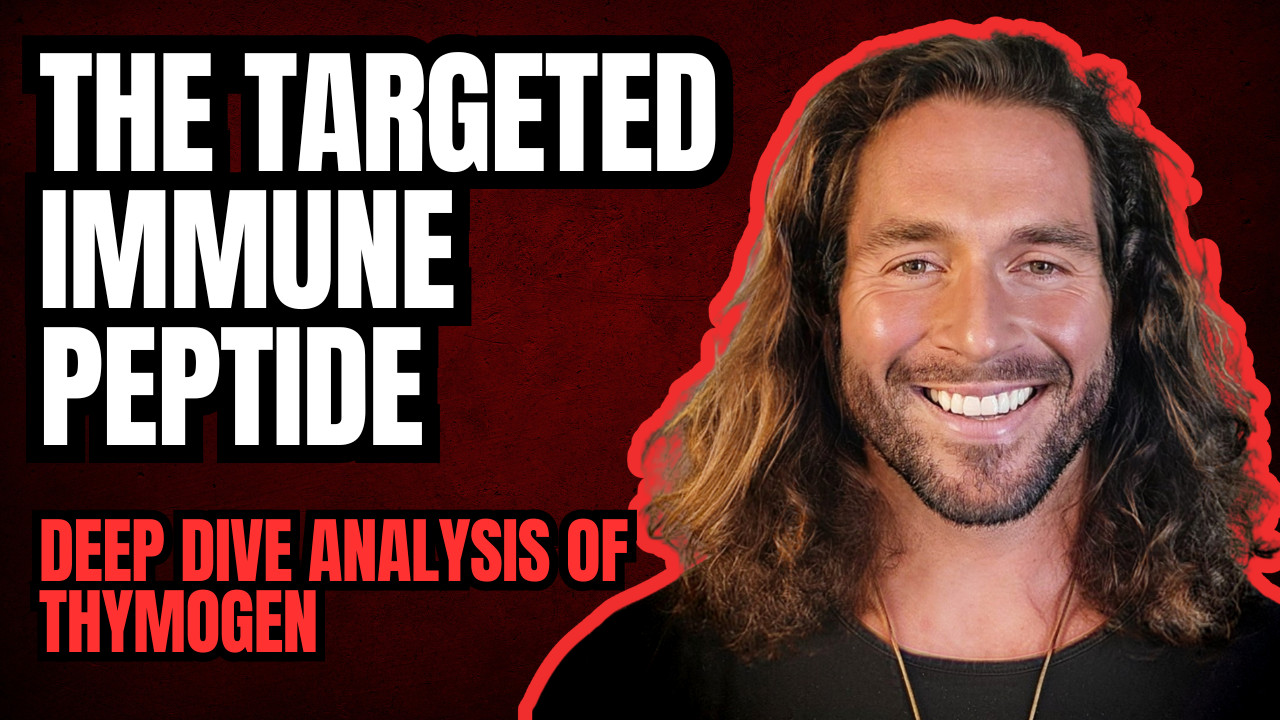
Most of you have heard me talk about Thymalin, and I love Thymalin. I’ve used it extensively. I view it as a broad-spectrum thymus reset that engages many immune “levers” simultaneously.
Thymogen is different.
Thymogen is more targeted, especially for the “post-viral” use case, lingering immune stress, and times of year when colds and flus are everywhere.
In the episode, I walk you through what it is, how it works, how to dose it, and how I’d stack it with Thymalin if you want the best of both worlds.
Background
Thymogen is a synthetic dipeptide known as L-glutamyl-L-tryptophan.
As we age, the thymus tends to shrink and become less active (thymic involution), and that contributes to declining immune defenses.
Practically, that shows up as people getting sick more often, taking longer to recover, and having a harder time “clearing” things that their body used to handle easily.
Thymogen was developed and used clinically in Russia for decades as an immunomodulatory tool.
One of the reasons I got more interested in it is that there’s a meaningful amount of human experience with it over time, along with animal data that’s genuinely intriguing from a longevity standpoint.
So if you’re the kind of person who thinks about immune function as a pillar of healthspan, Thymogen belongs on your radar.
Mechanisms
At the cellular level, Thymogen supports T-cell maturation.
In plain English, it helps the body turn “immature” immune cells into functional T-lymphocytes that can actually do their job.
It also supports immune surveillance, which is your immune system’s ability to recognize what’s foreign, what’s infected, and what’s abnormal.
It also appears to support components of the innate immune response, including things like neutrophil movement (chemotaxis) and phagocytosis (the immune system’s “cleanup crew”).
At the molecular signaling level, Thymogen gets even more interesting. In research models, it influences pathways connected to cell signaling and protein synthesis, including ERK-related signaling and mTOR-adjacent proteins.
It’s also been associated with STAT1-related signaling, which matters because STAT signaling is one of the ways immune cells “decide” how to respond.
It also may influence gene expression by shifting chromatin into a more active state.
The simple model I use is that Thymogen nudges immune function toward a more youthful, resilient pattern.
Benefits
The most obvious benefit is immune resilience. For a lot of people, Thymogen fits into the category of “I want to get sick less often, and when I do get sick, I want to recover faster.”
Second, Thymogen can be useful for the “something is lingering” scenario.
You know the feeling.
The acute phase passes, but the fatigue and the immune drag hang around longer than they should. This is one of the reasons I describe Thymogen as a strong post-viral tool.
Third, I like it for inflammation management in the context of immune balance.
In research settings, it’s been associated with reductions in pro-inflammatory cytokine signaling when inflammation is excessive.
Fourth, there’s a performance-and-recovery angle people miss.
Immune function is part of recovery after travel, poor sleep, hard training blocks, surgery, and injury. That’s why I like having it on hand during high-stress seasons of life.
Clinical Results
One of the reasons Thymogen has stayed on my shortlist is that it isn’t a brand-new mystery compound with zero history.
There’s a substantial body of use and research from Russia and Eastern Europe, plus animal data that creates a compelling longevity conversation.
In animal models, long-term Thymogen use has been associated with improvements in markers of aging trajectories, including notable lifespan extension in certain study designs.
There are also data points around the reduction in tumor incidence in aging animals.
On the human side, Thymogen has been used as an immunocorrective tool in settings such as immune suppression, recovery, and during respiratory illness seasons.
There are reports of improved immune profiles in older or immunocompromised individuals when thymus-oriented peptides are added to broader care.
Thymogen has a reputation for being well-tolerated with minimal side effects when used appropriately, which is exactly what you want from something you might run once or twice per year as a longevity tune-up.
Dosage
Here’s my go to dosing protocol.
Thymogen: 1–2 mg per day for 30–60 days.
That’s a long enough window to allow immune cell turnover and signaling shifts to actually matter.
I usually treat it as a seasonal tune-up once or twice per year.
If you’re healthy and just longevity-minded, once per year is often plenty. If you’re in a high-stress season of life, travel-heavy, sleep-deprived, or constantly exposed to people getting sick, twice per year can make sense.
Route-wise, I prefer subcutaneous injections for practicality. Intramuscular works too.
There’s also a nasal spray form used for mucosal immune support in certain contexts, but for longevity goals I default to injections.
I also like cycles because Thymogen is, in my mind, a reset button, not a permanent crutch. You run it, you let the immune system stabilize, and you reassess.
And if you’re the person asking, “What about stacking?” Here’s the concept:
Thymalin can serve as the broad foundation at 2mg per day for 30-60 days
Thymogen can serve as the targeted fine-tuning phase
A simple approach is to start with Thymalin for a short block, followed by Thymogen for 4–8 weeks.
FInal Thoughts
Thymogen is a targeted immune bioregulator peptide that I like for:
Post-viral recovery and lingering immune fatigue
Cold/flu season support as a proactive “keep it on hand” tool
Immune resilience during stress (travel, poor sleep, heavy training, demanding work seasons)
Longevity-focused immune optimization, especially as thymus function declines with age
Supporting a more balanced immune response rather than simply “stimulating” everything
Thymalin vs Thymogen in one sentence:
Thymalin feels like a broad thymus reset
Thymogen feels like precision immune fine-tuning, especially for T-cell support and seasonal use cases
If you want to go deeper, the podcast episode walks through the slides, the mechanisms, and how I think about stacking Thymogen with Thymalin (and even where Thymosin Alpha-1 could fit if you’re trying to cover every base).
And as always, thank you for being here. I couldn’t do this without you!
Best,
Hunter Williams
P.S. BioLongevity Labs is offering Thymogen for 40% off with an additonal 15% off when you use code HUNTERW at checkout. You can also buy 3 and get 1 free! (that comes out to $35.40 per vial when you get 4).
Further Reading